
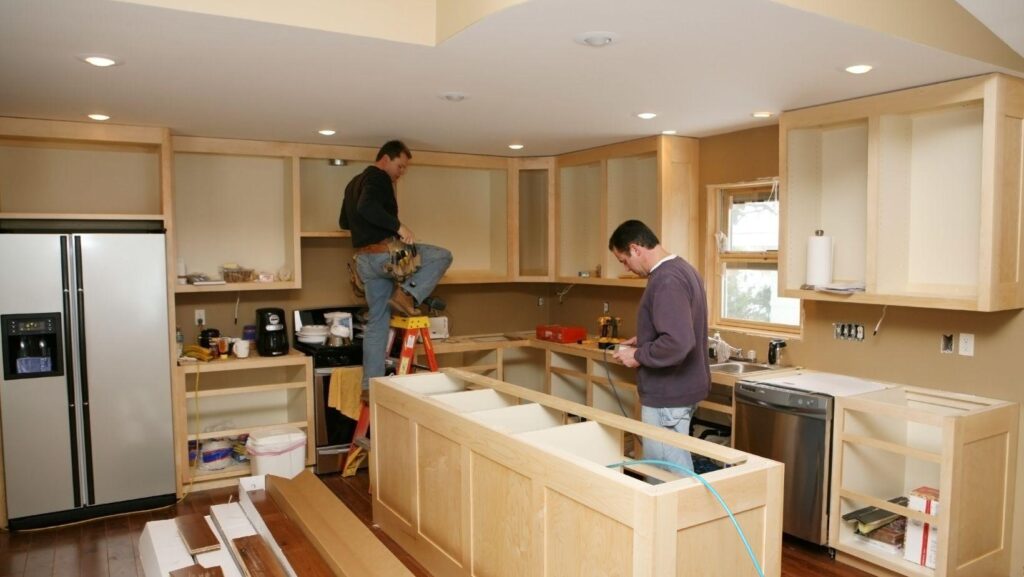
Nobody plans to move the sink. The sink gets moved anyway – usually around week four, by someone holding a tile sample and saying “while we’re at it.” That’s how kitchen budgets die. Not in one dramatic decision. They die in two quiet places: the scope slowly fuzzes over, and the way everything gets paid for adds costs that were never in the spreadsheet. Fees. Interest. A wire that went somewhere it shouldn’t have.
The fix isn’t two fixes. It’s one system: decide what’s getting built, price it honestly, then pay for it in ways that protect the budget instead of nibbling at it.
Step one: admit what the project actually is
Three kinds of kitchen projects exist. A refresh stays on the surface – paint, hardware, a faucet, maybe a pendant light. Nothing moves. A partial remodel reaches into the expensive organs – cabinets, counters, appliances – but the plumbing and electrical stay put. A full remodel means layout, walls, plumbing runs, circuits, ventilation. Sometimes a window, at which point it’s not really a kitchen project anymore, it’s a small construction company with a house attached.
Picking the tier isn’t paperwork. It’s a fence. The fence has one job: making sure every “one more thing” arrives carrying a price tag instead of slipping through the gap where the definition should have been.
Two lists, and one of them gets no respect
The done list is the brief: cabinet style, counter material, appliances, lighting plan, flooring, finish level. Plain language, actual nouns. “Mid-range quartz” is a decision. “Nice counters” is a future argument with receipts.
The not-doing list is the one nobody wants to write and the one that saves the money. No recessed lighting added midstream. No sink moved “a few inches.” No panel upgrade “while the walls are open” – which are, for the record, the four most expensive words in renovation, and it’s not close. No appliance size changes after the cabinets are ordered. Writing it down feels rigid. It feels rigid for about six weeks. Then it feels like genius.
Step two: buckets, not a number
“Kitchen – $25,000” is a wish wearing a spreadsheet costume. A working budget comes in buckets: design and measurement, demo and disposal, cabinets, counters, appliances, plumbing fixtures, electrical and lighting, flooring, paint, labor, permits, delivery fees, cleanup. Even a refresh deserves the buckets, because small purchases pile up. They pile up quietly. One homeowner in Dayton actually tracked hers and found $1,900 in delivery fees and “little stuff” that had somehow bypassed the budget entirely. Nineteen hundred dollars of nothing in particular.
Buckets also expose what quotes are hiding. Two bids that differ by five grand almost never differ on the work – they differ on the assumptions. Who’s paying for disposal. Who pulls permits. What “finish carpentry” supposedly covers. Line items drag all of that into the light, where it can be argued with.
The contingency, or: the seatbelt
Kitchens hide things. Water damage behind the sink base. A subfloor with opinions. A vent that turns out to vent into the attic, which is not venting – that’s just relocating grease somewhere darker. Ten to twenty percent, held as a separate line. Separate, because unfenced money gets spent mentally long before the first cabinet arrives.
The buffer’s real job isn’t even the surprise itself. It’s stopping a funding problem from becoming a quality problem: cheaper tile bought in a panic, the rushed install, the trim detail that quietly never happens and then bothers someone every single morning for nine years.
The calendar problem
This is the part that feels like overkill until it isn’t. Affordability is timing, not just totals. Deposits, milestone payments, the appliance order, counter fabrication – map when each one lands, because a project can be “within budget” on paper and still detonate a household when three large payments stack into the same week. Ask anyone who’s put a counter deposit on a credit card at 24% because the money existed, just not that week. The money always exists. The week is the problem.
So the payment schedule gets tied to phases, laid against actual cash availability, and the scope gets adjusted before signing. Before. The other direction doesn’t work.
Step three: spend where the days are long
Daily friction writes the priority list. Storage that fits the actual cookware. Light over the cutting board instead of shadow. A layout that ends the morning collision at the coffee maker-every kitchen has one, some corner where two people physically cannot pass, and fixing it is worth more than most countertops.
The test is simple. If an upgrade makes cooking safer, faster, or easier to clean, it goes early. If it mainly photographs well, it waits. It waits. Keeping the renovation fund separate from other spending goals-whether you plan to book a holiday or buy Litecoin online-helps protect those priorities and makes the available budget easier to track.
And then the boring rule, the one that saves real money: sequence. Rough plumbing and electrical before finishes. Venting before cabinets. Flooring timed against cabinets and appliances so the heights don’t get weird. Get the order right and each stage supports the next. Break it and the project can pay twice for the same square footage. Sometimes three times-a thing that happens to people who “just want to see progress” and order the floors early.
Step four: the money, before anyone asks for it
Payment methods look like plumbing. Neutral pipes. They’re not – each one quietly changes the total. Cash is simple, and simple is underrated. Cards protect purchases and punish balances. Financing smooths the weeks and inflates the total, especially the promotional kind, which gets its own paragraph below and earns it. Most kitchens end up hybrid – financing for labor, cash for appliances, a card for the small stuff – and that’s fine. The rule is matching money to spend. A scheduled contractor draw is not the same animal as the microwave that dies in week two. (The microwave always dies in week two. It’s like they know.)
Two guardrails, written down while everyone’s calm. A maximum monthly payment that leaves room for actual life. And a short list of no-surprise rules: no financing without a stated total cost, no contracts with blank change-order language, no off-platform payment requests from anyone ever. That last one isn’t a convenience preference. It’s the fraud rule wearing a trench coat.
Every payment method, honestly
Credit cards. The rewards are fine. The rewards are not the point – the point is dispute rights and a clean paper trail when something arrives broken or doesn’t arrive. Cards belong on smaller, trackable purchases paid off immediately: fixtures, hardware, lighting. Put a five-figure draw on a card and the interest starts eating the contingency from the inside.
Debit. Feels simple because the money just leaves. That is precisely the problem. A dispute mid-project can freeze funds at the worst possible moment – cabinets on a truck, crew standing around, checking account under review. Debit is for boring low-risk retail. Nothing where a freeze stops the job.
ACH and bank transfers. Low fees, good documentation, genuinely right for contractor invoices. The catch: verification sits with the payer. The name on the invoice matches the name on the account. Written instructions stay on file. And if the instructions change mid-project – a “new account,” a “temporary” routing number – that is not an update. It’s a fire alarm. Confirm through a number that existed before the email did.
Wire transfers. Fast, and effectively irreversible. That’s the feature. It’s also the danger – same sentence. Wire fraud works because deadlines make people hurry: template tomorrow, fabricator needs it today, everyone’s tired, everyone’s always tired by then. If a wire is truly required, the call-back happens every time, not most times – through a known contact, never the number at the bottom of the email requesting the wire.
Invoices and payment links. Efficient, milestone-friendly, and phishing’s favorite costume. Verify the sender. Check the invoice against work actually completed. If anything feels slightly off, pause. A two-day delay is cheaper than a mistake. It’s always cheaper than the mistake.
BNPL and installments. Fine for a bounded purchase with a clear payoff date – a faucet, a lighting package. The failure mode is stacking: four small plans, one combined monthly total, arriving as a complete surprise to the person who signed all four. If a purchase is part of a shifting scope, the math can’t be tracked, and untrackable math in a renovation is just future regret with a payment date.
Contractor financing and personal loans. These can genuinely work – fair rate, term matched to the project, total cost stated plainly. The trap is promo financing that flips into a vicious APR if the balance isn’t cleared in time, which is exactly what the promo period is designed to produce. Read the total cost, the term, the prepayment rules. Remodels change mid-stream. The financing shouldn’t punish normal behavior.
Checks and cash. Checks are slow, slightly annoying, and create a beautiful paper trail. Some contractors still prefer them – possibly the last people in America who do – and honestly, the instinct is sound. Cash is the opposite: weak documentation, no dispute ability, no business anywhere near a major payment. Small cash purchases get a signed receipt, immediately, into the folder. Not later. Later doesn’t happen.
The rules that prevent the disaster story
Fraud doesn’t kick the door in. It changes one digit. A new routing number, a “temporary” account, an email address with one letter swapped, a tone of gentle urgency. The countermeasure is boring consistency: vendor details confirmed through known contacts, payment instructions re-checked at every milestone, even when it feels repetitive. Especially when it feels repetitive. Consistency is the safety signal. Sudden changes and pressure are the other thing.
Payments attach to milestones – demo done, rough-in passed, cabinets delivered, install complete, punch list finished. Promises are not milestones. Calendar dates are not milestones. Front-loaded schedules are how jobs get abandoned; balanced ones keep everyone honest without anybody having to say the word honest out loud.
And the folder. Invoices, receipts, signed change orders, photos – digital or paper, doesn’t matter, as long as it exists. The change-order log earns its own sentence: every change recorded with what, why, cost, schedule impact. Feels like paperwork. Behaves like a referee.
The scorecard, briefly
Six ratings per payment method: total cost, reversibility, speed, documentation quality, fraud risk, and whether the contractor takes it – and at what fee. Then weight by stakes. Big payments get boring, protected, documented rails. Small ones can have convenience and points; points are real, they’re just not worth weak protection on five figures. One percent back on a payment that goes wrong is a rounding error next to a catastrophe.
Where it goes wrong, usually
The ripple nobody priced. Moving the sink is permits, patching, and cabinet modifications. A bigger fridge is an electrical update and a vent question wearing a fridge costume. One question prevents most of it: what else has to change for this to work?
The rewards-first payment choice. Covered above, worth repeating, so: repeated.
The ignored calendar. Delays generate their own costs – storage fees, expedited shipping, extra labor days, rushed decisions that become returns. Slack in the schedule is often the cheapest line item in the whole project, and nobody budgets for it because it doesn’t look like anything. It looks like nothing. That’s the trick.
The checklist
Before anything starts:
- Name the tier. Fence it.
- Write the done list. Write the not-doing list. Guard the second one harder.
- Build the buckets: design, demo, cabinets, counters, appliances, fixtures, electrical and lighting, flooring, paint, labor, permits, delivery, cleanup.
- Contingency, 10-20%, its own line, mentally spent by no one.
- Map the cash calendar: deposits, milestones, big purchases by phase.
- Assign payment methods by transaction type – materials, online orders, contractor draws.
Before every payment:
- Verify the sender through a known contact. Never the number in the email.
- Re-check the instructions. Yes, again. Especially wires and ACH changes.
- Refuse off-platform anything, politely and completely.
- Financing terms in writing: total, term, prepayment.
- Pay against completed milestones. Promises don’t count. Dates don’t count.
- File the proof. Photos too. The log too.
Twenty minutes a week. The alternative is a dispute with no documentation, which takes considerably longer and involves more hold music.
The part nobody frames
The kitchens that finish on budget aren’t the ones with the most money. They’re the ones where the scope had a fence, the costs had a calendar, and every payment traveled on rails chosen for protection instead of convenience.
Nobody tapes the budget spreadsheet to the fridge when it’s over. What goes in the kitchen is the kitchen – finished, working, the morning collision peacefully resolved. The spreadsheet was just how it got there with the money and everyone’s tempers intact.